IRS Automatic Penalty Relief: The New AEP Program Explained

Updated: Sep 7
The IRS has announced a significant change to administrative penalty relief for compliant taxpayers. In IR-2026-83, issued July 8, 2026, the IRS introduced a new program called Automatic Exemption from Penalty (AEP), which is set to begin this summer and will deliver IRS automatic penalty relief by preventing the assessment of certain penalties for eligible taxpayers with a strong compliance history.
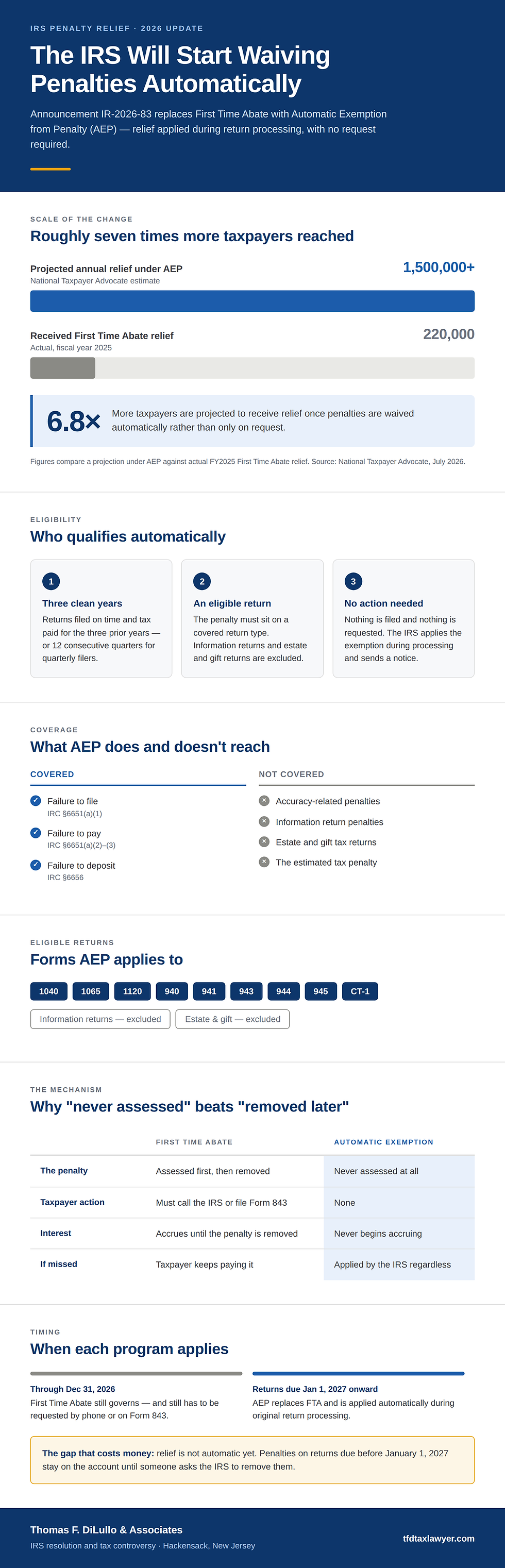
How the IRS automatic penalty relief program works
The new AEP program is designed to replace the long-standing First Time Abate process for many eligible returns. Under the announcement, taxpayers generally qualify for IRS automatic penalty relief if they timely filed returns and paid the tax due for the prior three years — or for 12 consecutive quarters in the case of quarterly returns.
If a taxpayer qualifies, the IRS says it will automatically apply relief during processing, without requiring the taxpayer to request it. The IRS will then issue a notice confirming that the relief was granted — no response is needed. The relief applies to three common penalties:
Failure to file — IRC §6651(a)(1)
Failure to pay — IRC §6651(a)(2)–(3)
Failure to deposit — IRC §6656 (generally for payroll tax returns)
AEP applies to eligible original returns beginning with tax year 2025 and 2026 quarterly returns, as well as future periods. The IRS lists Forms 1040, 1065, 1120, 940, 941, 943, 944, 945, and Form CT-1 as eligible return series. Full eligibility criteria are set out on the IRS's Administrative Penalty Relief page.
Mercy for Qualified Taxpayers
The IRS's new Automatic Exemption from Penalty (AEP) program applies relief automatically for taxpayers with a clean compliance record — no request required. If you've filed and paid on time for the past three years, you may already qualify.
Important limits on automatic penalty relief
This is not a blanket penalty waiver. The IRS made clear that not all returns are eligible for automatic penalty relief. Information returns — and returns filed only because of specific transactions or infrequent events, such as Forms 706 (Estate Tax Returns) and 709 (Gift Tax Returns) — generally are excluded.
The IRS also emphasized that AEP only affects certain penalties. Taxpayers must still pay any underlying tax and interest due, along with penalties that fall outside the program's scope (for instance, an accuracy-related penalty under §6662).
Taxpayers who do not qualify for AEP may still request penalty relief based on reasonable cause. The IRS will review those requests and notify the taxpayer of the outcome.
Transition from First Time Abate to AEP
The IRS will phase out First Time Abate as AEP is implemented. During the transition, some taxpayers may still receive penalty notices for eligible 2025 tax year returns and 2026 quarterly returns. In those cases, taxpayers who believe they qualify may still need to contact the IRS and request First Time Abate.
There is a meaningful mechanical difference between the two. Under First Time Abate, the penalty is assessed first and then removed on request. Under AEP, no penalty is assessed at all — so it never accrues.
For eligible returns with original due dates on or after January 1, 2027, AEP is expected to replace First Time Abate entirely.
Why IRS automatic penalty relief matters for taxpayers
This change should reduce the administrative burden for taxpayers who historically complied but previously did not know whether they qualified — or even knew enough to ask for a first-time penalty abatement. As a result, many eligible taxpayers may have missed relief simply because they did not know to request it.
The scale of that gap is significant. According to the National Taxpayer Advocate, roughly 220,000 taxpayers received First Time Abate relief in fiscal year 2025 through the manual request process. TAS estimates that had AEP been in place over the same period, more than 1.5 million taxpayers would have received relief — about seven times as many.
In practical terms, the announcement reflects a move toward more systematic and automatic administration of penalty relief for taxpayers with a clean compliance record.
Conclusion
IR-2026-83 signals a meaningful procedural shift in IRS penalty administration — one aimed at a fairer, more equitable tax compliance system. For eligible taxpayers, the new AEP regime should make IRS automatic penalty relief from certain common penalties more accessible by applying it automatically, rather than requiring a formal request.
Frequently asked questions about IRS automatic penalty relief
Do I need to apply for IRS automatic penalty relief?
No. AEP is applied automatically when your original return finishes processing. If you qualify, the IRS will not assess the penalty and will send you a notice confirming that relief was granted. You do not need to contact the IRS or respond to that notice.
Who qualifies for the AEP program?
You generally qualify if the same return type was timely filed — and any tax due was paid — for the prior three years, or for 12 consecutive quarters in the case of quarterly filers. Business filers face additional conditions, including that the IRS did not waive the failure-to-deposit penalty four or more times in that lookback period.
Which penalties does AEP cover?
Three: failure to file (IRC §6651(a)(1)), failure to pay (IRC §6651(a)(2)–(3)), and failure to deposit (IRC §6656).
Which returns are eligible for AEP?
The IRS lists Forms 1040, 1065, 1120, 940, 941, 943, 944, 945, and Form CT-1. Information returns and returns filed only in response to specific transactions or infrequent events — such as Form 706 (Estate Tax) and Form 709 (Gift Tax) — are not eligible.
When does the AEP program start?
The IRS announced AEP on July 8, 2026 in IR-2026-83, with the program beginning in summer 2026. It applies to eligible original returns starting with tax year 2025 and 2026 quarterly returns.
What is the difference between AEP and First Time Abate?
Under First Time Abate, the penalty is assessed first and then removed after the taxpayer requests relief. Under AEP, no penalty is assessed at all, so it never accrues. First Time Abate requires a request; AEP does not. AEP fully replaces First Time Abate for eligible returns with original due dates on or after January 1, 2027.
Does AEP eliminate my tax and interest?
No. AEP prevents the assessment of certain penalties only. You remain liable for any underlying tax, interest, and any penalties outside the program's scope — for example, the accuracy-related penalty under §6662.
What if I don't qualify for AEP?
You may still request penalty relief based on reasonable cause. The IRS will review the request and notify you of the outcome.
I received a penalty notice but think I qualify. What should I do?
During the transition, some qualifying taxpayers may still receive penalty notices for eligible 2025 tax year and 2026 quarterly returns that were processed before AEP went live. Contact the IRS and ask whether AEP, First Time Abate, or reasonable cause relief applies to your situation.
Sources
If you have received an IRS penalty notice or want to know whether you qualify for relief, contact Thomas F. DiLullo & Associates, P.C. to discuss your options.